- sales@fokca.com info@fokca.com
- WhatsApp: +86 150 5749 1870

Custom Cylinders & System Solutions Manufacturer | Est. 1998
Custom Cylinders & System Solutions Manufacturer | Est. 1998

Dec 09, 2025
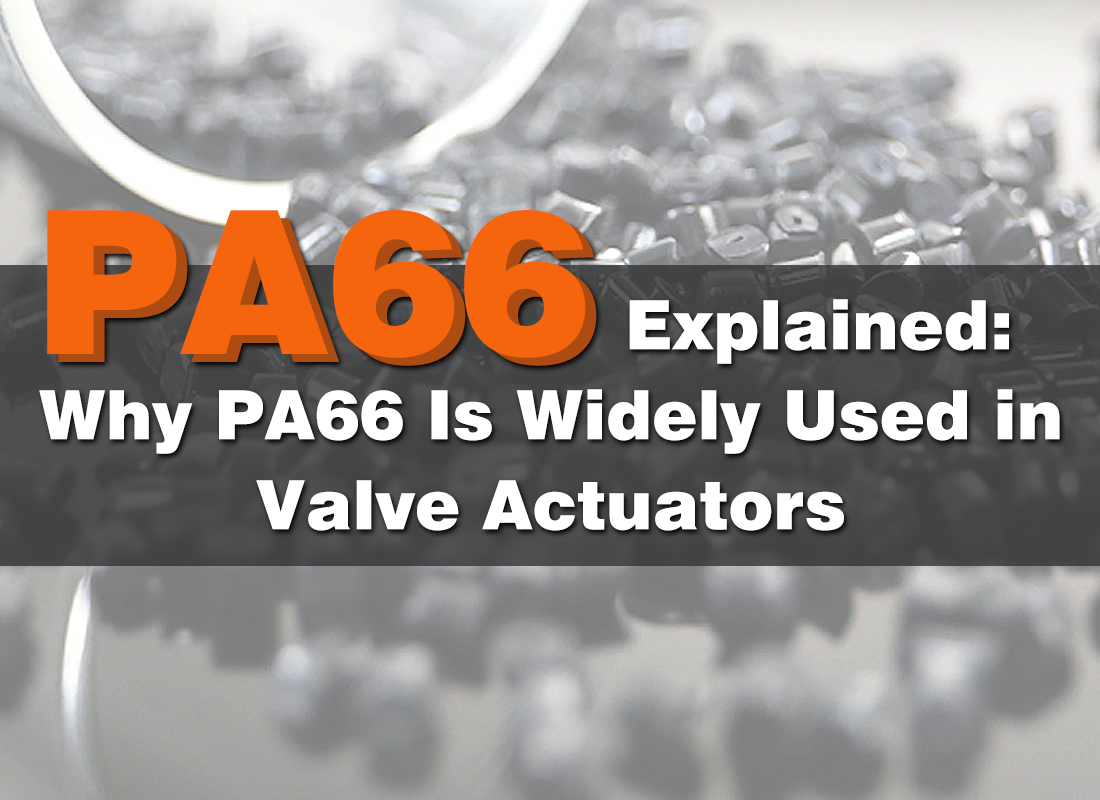
When you take a closer look at an angle seat valve or many industrial valve actuators, you will often see that the black actuator housing is made from a material known as PA66, also called Nylon 66. In recent years, PA66 has become one of the most widely used engineering plastics for pneumatic and mechanical actuator components. Its exceptional combination of strength, wear resistance, fatigue resistance, chemical resistance, and cost-performance makes it an ideal choice for demanding valve applications.
This article explains why PA66 has become the “standard material” for valve actuator housings, how it compares with metals, and when choosing stainless steel or other materials becomes necessary.
PA66 (Polyamide 66) is a high-performance engineering plastic known for its excellent mechanical properties. Because of its durability, stability, and ability to maintain performance under stress, PA66 is commonly used in automotive components, gears, industrial equipment, and—most notably—valve actuators.
In angle seat valves, solenoid valves, and pneumatic actuators, PA66 is often the default material for external housings and structural components.
A valve actuator must withstand internal air pressure as well as external mechanical force during operation.
PA66 offers:
High tensile strength
High stiffness
Strong impact resistance
These characteristics allow PA66 actuator housings to remain rigid and reliable even during frequent open-close cycles or under high operating pressure. For most applications, PA66 provides sufficient structural safety without needing heavy metal housings.
Valve actuators operate in environments that involve repeated movement, friction, and vibration. PA66 is naturally wear-resistant and capable of maintaining its mechanical integrity over long periods.
This reduces the likelihood of:
Surface abrasion
Mechanical fatigue
Premature failure in actuator components
This excellent wear resistance is a key reason PA66 housings can survive millions of operating cycles.
Another major advantage of PA66 is its self-lubricating properties. Although it is often reinforced with additives like graphite or PTFE to improve friction performance, even pure PA66 significantly reduces wear between moving parts.
This helps:
Improve actuator efficiency
Reduce lubrication requirements
Extend service life of internal mechanical components
For applications requiring high-cycle operation, this becomes a significant benefit.
Valve actuators—especially pneumatic ones—operate with repeated start-stop cycles. PA66 can withstand continuous dynamic loading without cracking or deforming, making it ideal for long-term use in automation systems. Its fatigue resistance is significantly better than many other plastics and even competes with some lightweight metal alloys.
Valves frequently come into contact with air, steam, water, cleaning agents, oil mist, or even mild chemicals. PA66 has broad chemical compatibility:
Good resistance to oils
Good resistance to solvents
Stable performance against weak acids and bases
Because the actuator housing often operates near process fluids, chemical resistance is essential to ensure long-term reliability.
One of the biggest reasons PA66 dominates valve actuator applications is its cost effectiveness.
Compared with metals like stainless steel, PA66 offers:
Much lower material cost
Easier manufacturing (injection molding)
Lighter weight (reducing shipping and installation costs)
This makes PA66 a highly economical choice for large-scale manufacturing of valve actuators.
Although PA66 is very versatile, there are situations where metal, especially stainless steel, becomes necessary:
| Requirement | Recommended Material | Reason |
|---|---|---|
| Extremely high pressure | Stainless steel | PA66 cannot withstand heavy mechanical loads |
| Corrosive chemicals (strong acids/alkalis) | Stainless steel / special alloys | Metals provide superior chemical durability |
| High temperature environments | Stainless steel | PA66 softens at elevated temperatures |
| Explosion-proof or fire-safe use | Metal housings | Plastics do not meet fire safety requirements |
This is why high-end or harsh-environment actuators are often full-metal designs, while general-purpose industrial actuators use PA66.
PA66 (Nylon 66) continues to dominate the valve actuator industry because it offers an exceptional balance of:
Strength
Wear resistance
Self-lubrication
Fatigue resistance
Chemical stability
High cost-performance
For most industrial pneumatic and mechanical valve actuators, PA66 is the perfect all-round material—strong, durable, and economical. Only in extreme pressure, temperature, or corrosion environments does stainless steel become the better option.
In everyday applications such as angle seat valves, pneumatic ball valves, and small automation systems, PA66 remains the material of choice and will continue to play an irreplaceable role. If you need any types of valves, you can
contact us directly.
(FK9025)
You May Interest In



Get a free sample

FOKCA ©1998-2025 All Rights Reserved Sitemap