- sales@fokca.com info@fokca.com
- WhatsApp: +86 150 5749 1870

Custom Cylinders & System Solutions Manufacturer | Est. 1998
Custom Cylinders & System Solutions Manufacturer | Est. 1998

Mar 13, 2026

In baghouse filtration systems, the pulse solenoid valve is typically activated sequentially to maintain uniform cleaning of filter bags. However, improper controller configuration or system design may cause multiple valves to open at the same time.
In pulse solenoid valve for dust collector applications, each valve releases a large volume of compressed air within milliseconds. When several pulse jet solenoid valve units operate simultaneously, the compressed air supply may become insufficient, causing pressure fluctuations in the pipeline and affecting cleaning performance.
This issue is especially noticeable in large filtration systems or in installations with long compressed air pipelines.
In a typical pulse solenoid valve control system, compressed air is stored in an air reservoir and distributed through a pipeline network. When a pulse operated solenoid valve opens, a short but powerful burst of air flows through the blow pipe and into the filter bags.
Because of the high instantaneous airflow demand, pulse solenoid valve timing control is used to trigger valves sequentially rather than simultaneously.
If multiple pulse cleaning solenoid valve units are triggered together, the system may require a much higher air supply than the pipeline can deliver in a short period.
When several pulse solenoid valve in pneumatic systems operate at the same time, compressed air demand increases dramatically. This sudden demand can cause a temporary pressure drop in the air supply network.
The magnitude of the pressure drop depends on pipeline size, reservoir capacity, and the number of active valves. The following table illustrates the general relationship.
| Number of Valves Activated Simultaneously | Instant Air Demand | Pipeline Pressure Drop | Cleaning Efficiency |
|---|---|---|---|
| 1 valve | Low | Minimal | Stable |
| 2 valves | Moderate | Small | Slight variation |
| 3–4 valves | High | Noticeable | Reduced |
| 5+ valves | Very high | Significant | Unstable cleaning |
When pressure drops significantly, the airflow velocity generated by the pulse jet solenoid valve decreases, which weakens the cleaning pulse.
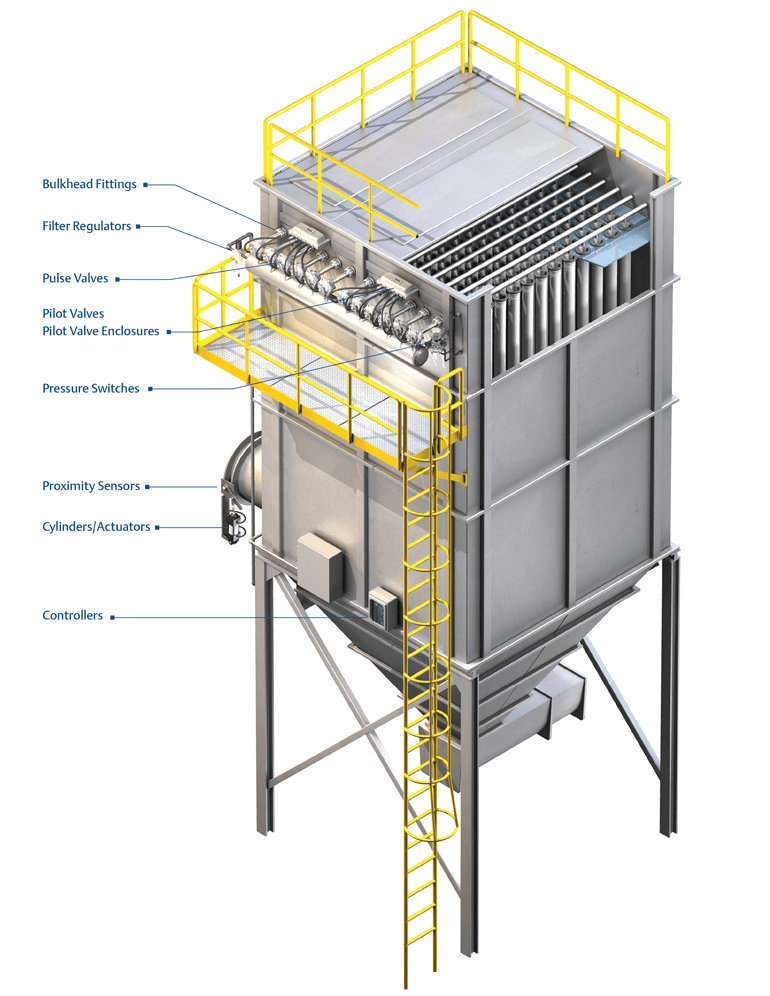
Uniform cleaning is essential in pulse solenoid valve for bag filter systems. When valves are triggered simultaneously, airflow distribution in the blow pipe network can become uneven.
Some filter rows may receive stronger air pulses while others receive weaker airflow. Over time, this imbalance can lead to uneven dust accumulation and higher filtration resistance.
In extreme cases, repeated pressure fluctuations may also contribute to pulse valve leakage problems or premature filter bag wear.
To prevent these issues, most solenoid valve pulse controller systems use sequential activation logic. The controller triggers each pulse solenoid valve for compressed air with a short time delay between pulses.
In large pulse solenoid valve for dust collector system installations, the pulse interval is typically set between one and several seconds. This allows pipeline pressure to recover before the next valve operates.
A properly configured pulse cycle solenoid valve sequence ensures stable airflow and consistent cleaning performance.
In real-world pulse solenoid valve sizing guide practices, simultaneous valve activation is generally avoided. Engineers designing dust collector systems often focus on maintaining stable compressed air supply conditions.
Typical recommendations include:
◆ Use a reliable solenoid valve pulse controller to manage pulse sequences
◆ Adjust pulse frequency solenoid valve settings based on system capacity
◆ Ensure sufficient air reservoir volume for peak demand
◆ Monitor pressure fluctuations and perform pulse solenoid valve troubleshooting when necessary
With proper system configuration, the pulse solenoid valve for pneumatic cleaning can deliver consistent cleaning performance even in large industrial filtration systems.
(FK9025)
You May Interest In





Get a free sample

FOKCA ©1998-2025 All Rights Reserved Sitemap