- sales@fokca.com info@fokca.com
- WhatsApp: +86 150 5749 1870

Custom Cylinders & System Solutions Manufacturer | Est. 1998
Custom Cylinders & System Solutions Manufacturer | Est. 1998

Mar 11, 2026

In industrial dust collection systems, the pulse solenoid valve releases compressed air in short bursts to remove dust from filter bags. While valve design and air supply pressure are important factors, the blow pipe orifice size also plays a critical role in determining the effectiveness of the pulse cleaning process.
Even a high-performance pulse jet solenoid valve may not achieve optimal cleaning performance if the blow pipe design restricts airflow or causes uneven distribution. In many pulse solenoid valve for dust collector installations, improper blow pipe sizing is a common reason for inconsistent cleaning performance.
In a typical pulse solenoid valve for baghouse system, compressed air stored in a reservoir is released through a pulse operated solenoid valve and enters a blow pipe. The pipe contains multiple nozzles that direct air pulses into individual filter bags.

The valve opening event usually lasts only a few milliseconds. During this short period, the pulse cleaning solenoid valve must deliver a strong airflow pulse through the blow pipe. Any restriction or imbalance in the pipe will influence how the air reaches each filter bag.
A properly designed pipe ensures that the airflow released by the pilot operated pulse solenoid valve is distributed evenly across all nozzles.
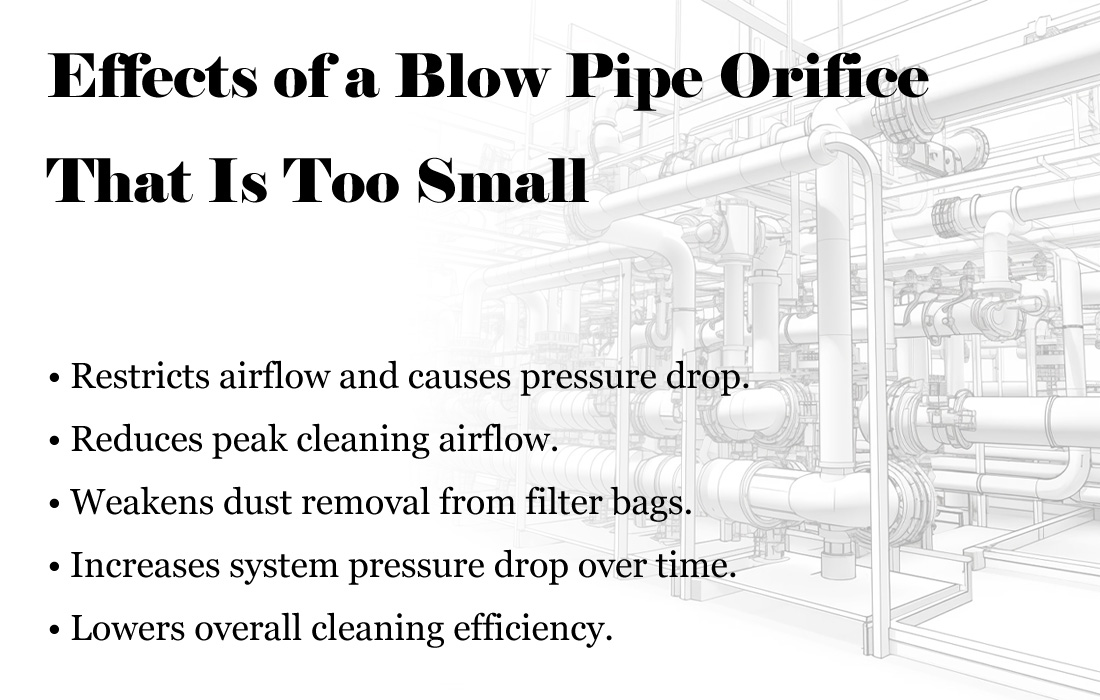
When the blow pipe orifice is too small, it acts as a restriction in the airflow path. Even with a high pressure pulse solenoid valve, the airflow may experience a significant pressure drop at the pipe entrance.
This restriction reduces the peak airflow generated by the pulse solenoid valve for filtration system, which weakens the cleaning pulse entering the filter bags.
As a result, dust layers may not detach effectively. Over time, the pressure drop across the filter system increases, and cleaning efficiency decreases.
In addition, small orifice sizes increase airflow resistance, which may extend the discharge duration in pulse solenoid valve in pneumatic systems.
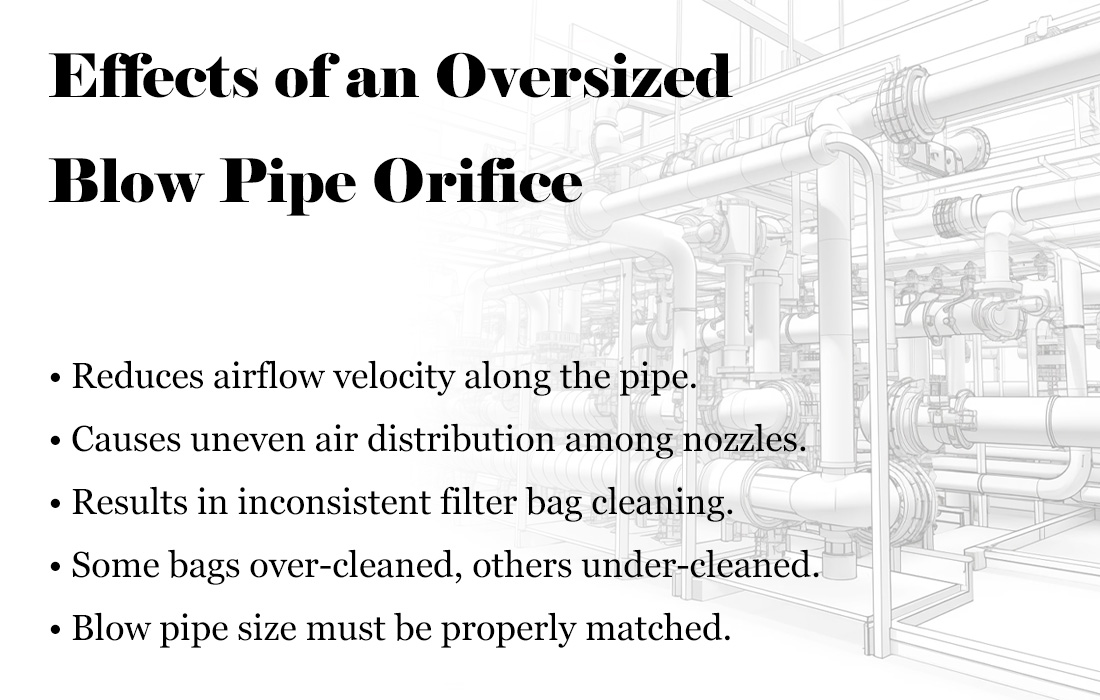
While a larger orifice reduces airflow resistance, it can also create uneven airflow distribution. In pulse solenoid valve for bag filter systems, multiple nozzles are positioned along the blow pipe.
If the pipe diameter is too large, airflow velocity decreases rapidly as it travels along the pipe. The nozzles closer to the valve may receive stronger airflow, while the ones farther away receive weaker pulses.
This uneven airflow distribution can lead to inconsistent cleaning across the filter bags. Some bags are cleaned effectively, while others retain dust layers.
Therefore, the pulse solenoid valve control system must consider blow pipe sizing carefully.
Proper matching between the valve capacity and pipe diameter ensures that airflow released by the valve can be effectively delivered to the filter bags.
Engineers usually refer to pulse solenoid valve specifications and system airflow requirements when designing the pipe.
| Blow Pipe Orifice Condition | Airflow Resistance | Air Distribution | Cleaning Efficiency |
|---|---|---|---|
| Too small orifice | High | Restricted | Low |
| Properly matched | Moderate | Uniform | High |
| Slightly large orifice | Low | Slight imbalance | Medium |
| Excessively large orifice | Very low | Uneven distribution | Unstable cleaning |
This comparison shows that only a properly matched design allows the pulse solenoid valve for pneumatic cleaning to deliver consistent cleaning energy.
In industrial pulse jet valve for industrial automation applications, engineers determine blow pipe diameter by considering several factors:
◆ Valve flow capacity
◆ Number and spacing of nozzles
◆ Blow pipe length
◆ Compressed air supply pressure
These parameters directly affect how the pulse cycle solenoid valve distributes airflow during each cleaning cycle.
To ensure reliable operation of a pulse solenoid valve for dust collector system, engineers often follow these practices:
◆ Inspect blow pipe nozzles regularly to prevent blockage
◆ Evaluate pipe sizing when modifying the dust collector system
◆ Perform pulse solenoid valve troubleshooting if cleaning performance declines
◆ Review valve and pipe matching based on a pulse solenoid valve sizing guide
Proper blow pipe design allows a fast response pulse solenoid valve to deliver strong and evenly distributed air pulses, improving overall cleaning efficiency in dust collection systems.
(FK9025)
You May Interest In







Get a free sample

FOKCA ©1998-2025 All Rights Reserved Sitemap