- sales@fokca.com info@fokca.com
- WhatsApp: +86 150 5749 1870

Custom Cylinders & System Solutions Manufacturer | Est. 1998
Custom Cylinders & System Solutions Manufacturer | Est. 1998

Feb 16, 2026

In systems where multiple media share the same pipeline network, cross-contamination is one of the most underestimated risks. It often develops quietly—residual fluid trapped in valve cavities, actuator chambers exposed to process media, or microscopic leakage paths that go unnoticed during commissioning. Over time, these small issues can compromise product quality, damage downstream equipment, or violate hygiene regulations.
A diaphragm valve addresses this risk at a structural level. Unlike conventional shut-off valves, it uses a flexible barrier to physically separate the process medium from the actuator and mechanical components, making it a preferred solution in applications where cleanliness and isolation are critical.
In mixed-media or batch-processing systems, contamination rarely comes from a single failure point. More often, it originates from valve internals. Traditional valve designs—such as globe or ball valves—contain cavities, stem packings, and dead zones where fluid residues can accumulate. When the system switches to a different medium, these residues are released into the new flow.
This problem becomes more pronounced in automated systems. A pneumatic control valve cycling frequently may expose its stem seals and actuator interfaces to splashing or vapor backflow. Over time, the boundary between mechanical motion and fluid control becomes blurred, creating pathways for cross-media interaction that are difficult to flush completely.
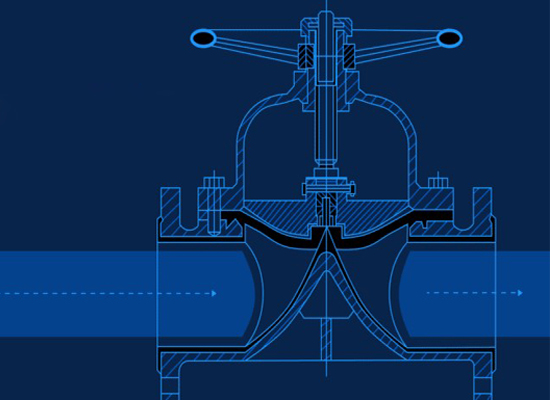
The defining feature of a diaphragm control valve is its complete separation of the process fluid from the drive mechanism. A flexible diaphragm—commonly made from PTFE, EPDM, or reinforced elastomers—forms a continuous barrier between the flow path and the actuator chamber.
Because the diaphragm moves up and down to regulate or shut off flow, there is no sliding stem seal exposed to the medium. This design eliminates leakage paths that are common in globe valves and reduces the internal surface area where residues can remain. In sanitary or corrosive environments, this isolation directly translates into improved safety and cleaner operation.
From a maintenance perspective, diaphragm valves simplify cleaning protocols. The flow path is smooth and free of complex cavities, especially in weir-type diaphragm valves, where the raised weir minimizes dead volume. During CIP or SIP cycles, cleaning agents can contact all wetted surfaces evenly, reducing the risk of trapped contaminants.
In pharmaceutical or food-grade systems, sanitary diaphragm valves are often selected not only for hygiene but also for process validation. Engineers can more easily demonstrate that no cross-contamination occurs between batches, a requirement that is increasingly strict in regulated industries.
| Valve Type | Media–Actuator Isolation | Internal Dead Zones | Cross-Contamination Risk |
|---|---|---|---|
| Diaphragm Valve | Full isolation via diaphragm | Minimal | Very low |
| Globe Valve | Partial (stem packing exposed) | Moderate | Medium |
| Ball Valve | None (cavity behind ball) | High | High |
This structural difference explains why diaphragm valve vs ball valve comparisons often favor diaphragm designs in clean or mixed-media systems.
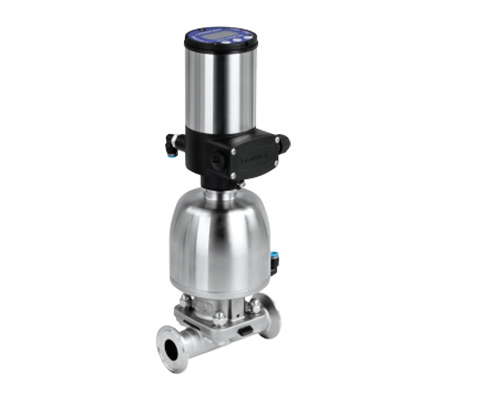
Modern systems increasingly rely on automation, and diaphragm valves adapt well to this trend. A pneumatic diaphragm valve with solenoid actuator allows remote operation while maintaining the same level of media isolation. The actuator never contacts the process fluid, even during rapid cycling.
In more complex installations, automated diaphragm valves with positioners or feedback signals enable precise control without introducing additional contamination risks. This makes them suitable for continuous processes where multiple fluids are switched frequently.
In chemical processing, diaphragm valves prevent aggressive fluids from attacking actuator components. In pharmaceutical applications, they ensure batch purity when active ingredients share transfer lines. Even in water treatment or semiconductor manufacturing, an industrial diaphragm valve helps maintain consistency when different cleaning agents or process fluids alternate within the same piping system.
For procurement teams, this isolation capability often justifies a higher initial cost by reducing long-term maintenance, product loss, and compliance risks.
(FK9025)
You May Interest In


Get a free sample

FOKCA ©1998-2025 All Rights Reserved Sitemap