- sales@fokca.com info@fokca.com
- WhatsApp: +86 150 5749 1870

Custom Cylinders & System Solutions Manufacturer | Est. 1998
Custom Cylinders & System Solutions Manufacturer | Est. 1998

Jan 29, 2026

In industrial automation, a 3 way solenoid valve is often treated as a simple on-off component. In reality, the internal switching sequence of flow paths plays a decisive role in system stability, especially in pneumatic and fluid control systems where pressure balance matters. When the switching order is not properly matched to the application, transient pressure spikes, unexpected actuator movement, or even repeated misoperation can occur.
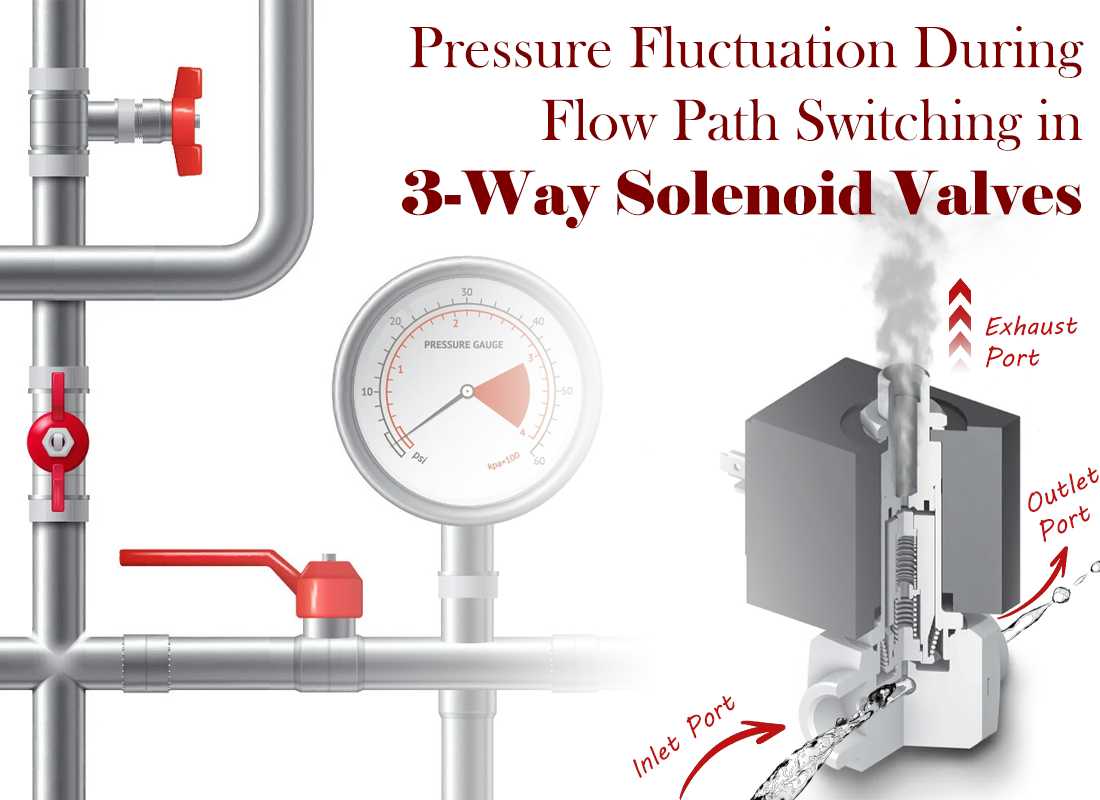
Unlike a 2-way valve that only opens or blocks flow, a 3/2 way solenoid valve manages three ports: supply, outlet, and exhaust. During switching, these ports do not change state simultaneously. Instead, the valve follows a defined internal path sequence—one port may close before another opens, or vice versa.
In a 3-way pneumatic solenoid valve, this sequence determines whether pressure is momentarily trapped, rapidly released, or briefly connected to multiple paths. For pneumatic directional control valve applications, even a few milliseconds of overlap or delay can change how an actuator behaves.
In theory, switching seems instantaneous. In practice, internal spool movement, spring force, pilot pressure, and coil response time all influence the actual transition. When the exhaust path closes before the supply opens, residual pressure may remain in the actuator chamber. When supply opens too early, a sudden pressure surge can occur.
This is why 3 way solenoid valve switching characteristics are critical in automation systems that rely on precise motion control. Poorly matched switching order often explains unstable cylinder motion that cannot be fixed by adjusting regulators or flow controls.
Pressure shock is one of the most common issues caused by improper switching. In high speed 3 way solenoid valve applications, fast coil response amplifies the effect. A sudden connection between supply and outlet while exhaust is still partially open can create turbulent flow and pressure oscillation.
In compressed air systems, this shock may manifest as vibration, noise, or premature seal wear. In liquid applications, especially when using an industrial fluid control solenoid valve, it can cause micro-hammer effects that shorten valve and piping life.

The switching sequence also varies between 3 way pilot operated solenoid valve and 3 way direct acting solenoid valve designs. Pilot-operated valves depend on pressure buildup to shift the main spool, which introduces a short delay but often results in smoother transitions. Direct-acting valves respond faster but may generate sharper pressure changes.
Choosing between pilot-operated vs direct acting 3 way valve designs should consider not only pressure range, but also how sensitive the system is to transient disturbances.
A 3 way normally closed solenoid valve and a 3 way normally open solenoid valve behave very differently during de-energized and energized states. In safety-related circuits, the exhaust-first or supply-first sequence directly affects how quickly pressure is released from actuators.

For 3 way valve for pneumatic cylinder control, an exhaust-first sequence is often preferred to prevent unintended movement when switching states.
| Valve Design Type | Typical Switching Order | Stability Impact |
|---|---|---|
| Direct-Acting 3 Way Valve | Supply opens before exhaust closes | Fast response, higher shock risk |
| Pilot-Operated 3 Way Valve | Exhaust closes before supply opens | Smoother transition |
| Normally Closed 3 Way Valve | Outlet vents first | Better fail-safe behavior |
| Normally Open 3 Way Valve | Supply reconnects early | Faster pressurization |
In modular systems using modular manifold solenoid valves, inconsistent switching sequences between valve models can introduce subtle timing differences. These differences may not appear during testing but show up during long-term operation, causing drift, noise, or actuator imbalance.
The issue becomes more pronounced in 3 way valve automation systems where multiple valves switch in coordinated cycles.
For 3 way valve for air actuator and motion control systems, switching sequence should be evaluated alongside flow rate, pressure, and cycle frequency. Applications requiring stable positioning benefit from valves with controlled exhaust timing and predictable spool movement.
In automation control solenoid valve selection, engineers often focus on voltage, port size, or mounting style, but overlooking internal switching order is a common root cause of field instability.
Whether used in industrial automation solenoid valves, compact pneumatic assemblies, or pressurized fluid systems, the internal logic of a 3 way solenoid valves design directly influences reliability. Selecting a valve purely by specification sheet without understanding its switching behavior increases the risk of shock, noise, and misoperation.
(FK9025)
You May Interest In











Get a free sample

FOKCA ©1998-2025 All Rights Reserved Sitemap