- sales@fokca.com info@fokca.com
- WhatsApp: +86 150 5749 1870

Custom Cylinders & System Solutions Manufacturer | Est. 1998
Custom Cylinders & System Solutions Manufacturer | Est. 1998

Feb 20, 2026
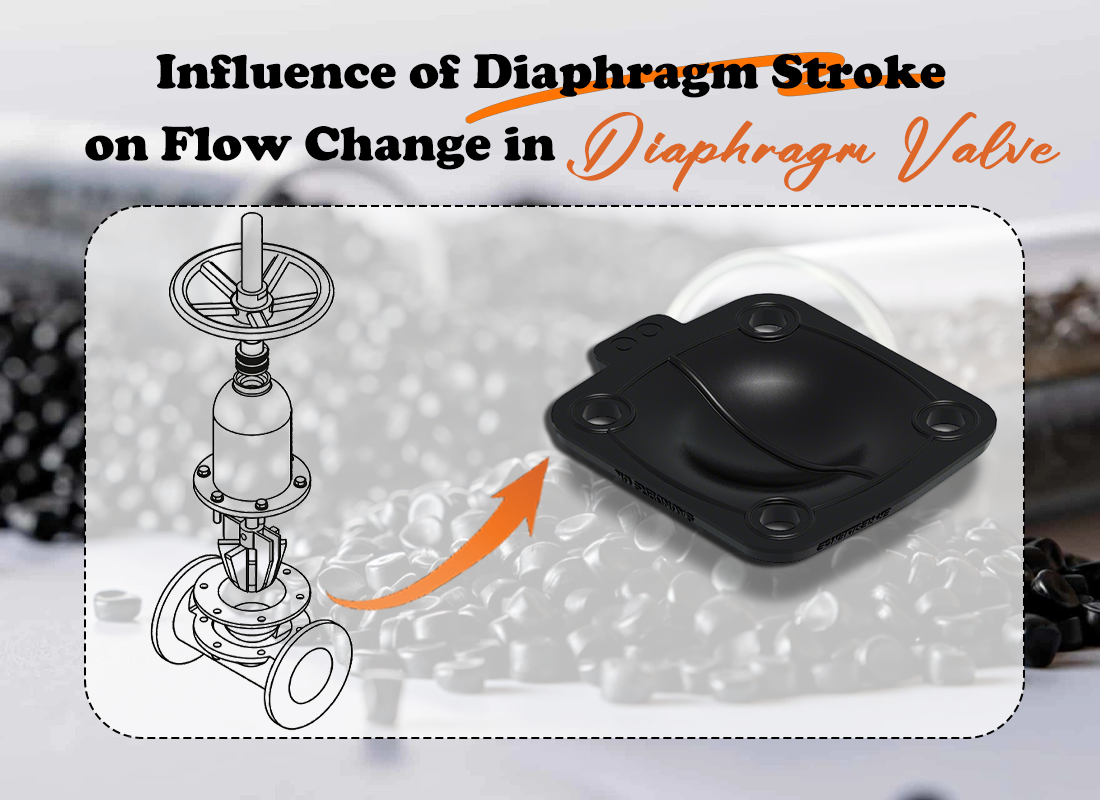
In fluid control systems, a diaphragm valve is more than an on/off component. It regulates flow through the deformation of a flexible diaphragm, and the stroke of the diaphragm directly determines the size of the flow passage. Unlike rotary valves, this mechanism creates a smooth and controllable relationship between movement and capacity, which is essential for engineers working with precise processes.
When the diaphragm moves slightly, only a narrow channel is opened. As the stroke increases, the effective area expands and the flow rises in a progressive but non-linear manner. A weir-type diaphragm valve shows stronger throttling characteristics, while a straight-through diaphragm valve offers a gentler curve suitable for higher throughput.
In a pneumatic diaphragm control valve, the real controllable zone is often smaller than the mechanical limit. Viscous liquids or particle-laden fluids amplify the sensitivity to small movements. Compared with a diaphragm shut-off valve used purely for isolation, regulating applications require careful matching between actuator resolution and process demand.
| Stroke Range | Flow Area Change | Typical Application | Stability |
|---|---|---|---|
| 0–20% | Very small increase | Micro dosing | High precision |
| 20–60% | Linear dominant | General regulation | Best |
| 60–100% | Saturation | On/off use | Limited |
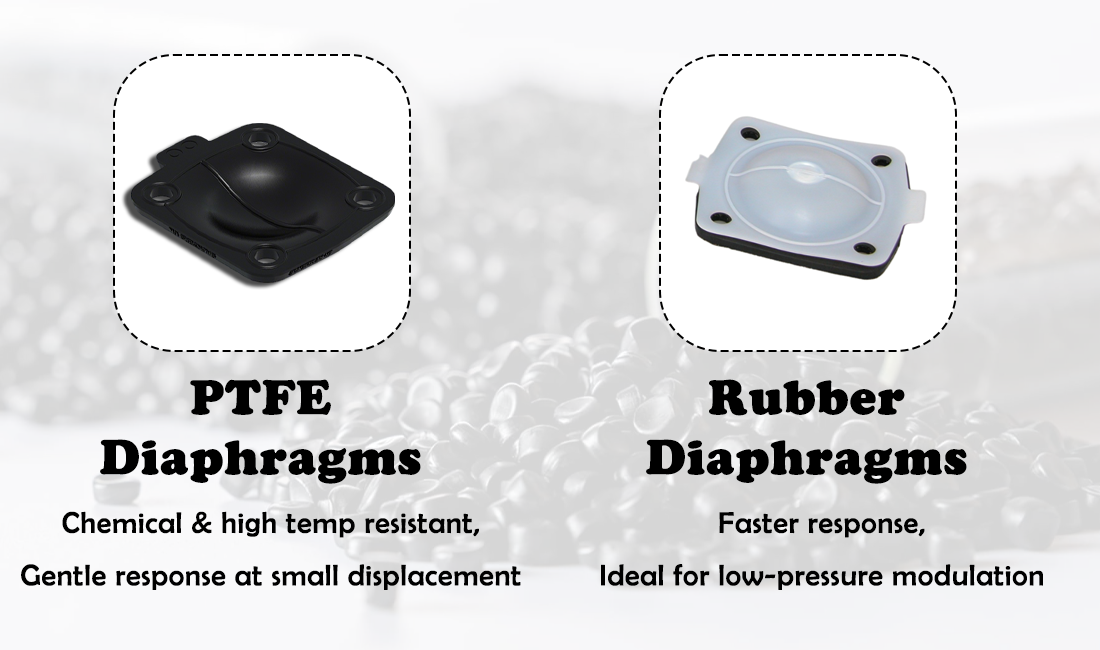
Material selection strongly affects performance. A PTFE diaphragm valve resists chemicals and high temperature but reacts more gently at small displacement. Rubber diaphragms respond faster and suit low-pressure modulation. In sanitary pneumatic diaphragm valve for food industry, excessive stroke may introduce turbulence and shorten service life.
Modern plants integrate diaphragm valve automation system with positioners so that stroke becomes a reliable indicator of flow. A remote controlled diaphragm valve can achieve near-linear regulation, which is difficult for rotary designs. The comparison of diaphragm valve vs ball valve clearly shows the advantage of diaphragm structures in fine control.
For industrial diaphragm valve in chemical processing, keeping the normal operating point within 30–70% stroke improves stability. If the system often works below 10%, a smaller size or dedicated micro-flow design is preferable.
◆ Diaphragm valve for pharmaceutical applications requiring minimal residue
◆ Diaphragm valve for chemical processing with corrosive media
◆ High temperature diaphragm valve with reinforced diaphragms
◆ 316L stainless steel diaphragm valve for hygienic lines
Understanding how stroke influences flow helps users avoid the common mistake of treating a diaphragm valve as a simple switch. When the movement of the diaphragm is matched with medium characteristics and actuator capability, the valve becomes a precise and reliable control element rather than just an isolator.
(FK9025)
You May Interest In


Get a free sample

FOKCA ©1998-2025 All Rights Reserved Sitemap