- sales@fokca.com info@fokca.com
- WhatsApp: +86 150 5749 1870

Custom Cylinders & System Solutions Manufacturer | Est. 1998
Custom Cylinders & System Solutions Manufacturer | Est. 1998

Jan 19, 2026
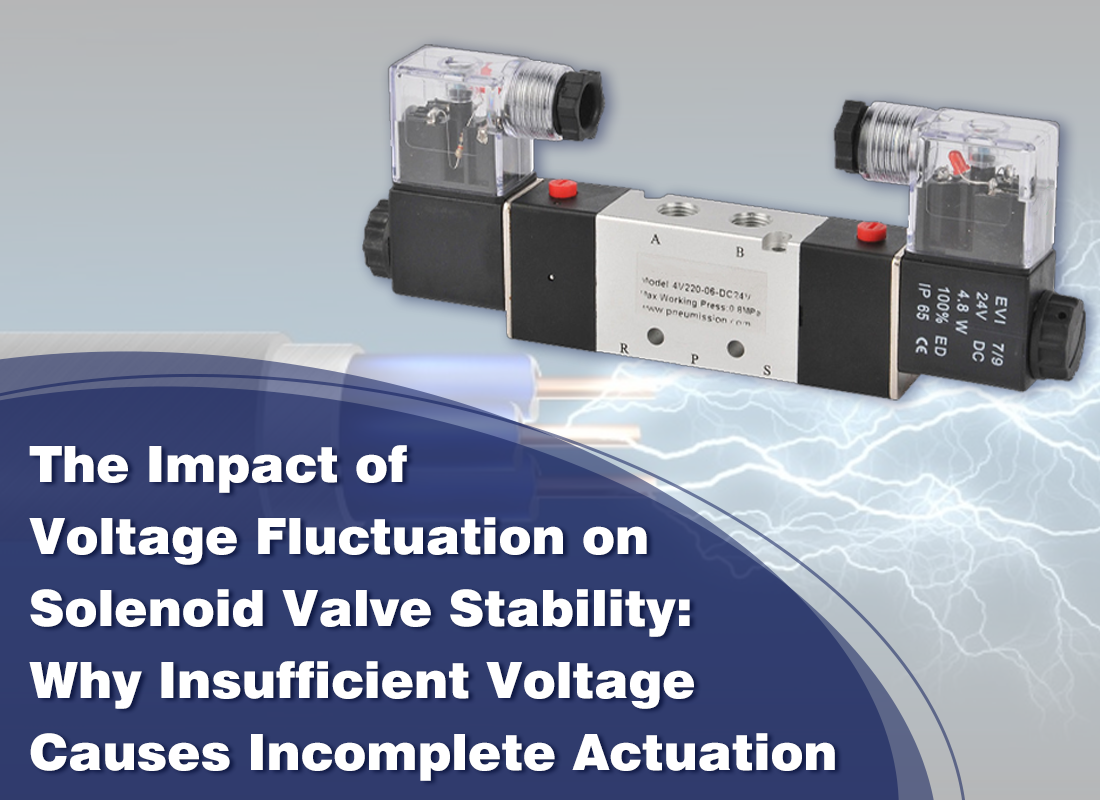
In many industrial systems, solenoid valves show unstable behavior even though no visible damage is found. Symptoms such as delayed response, random misoperation, or incomplete opening are frequently traced back to unstable power supply conditions. In facilities with aging electrical infrastructure or shared power loads, voltage fluctuation becomes a hidden but critical factor affecting solenoid valve performance.
A solenoid valve operates by converting electrical energy into electromagnetic force, which pulls the valve plunger against spring force, fluid pressure, and friction. This balance is calculated based on the rated voltage of the coil. When voltage remains stable, the electromagnetic force is sufficient to move the valve spool through its full stroke.
However, under voltage fluctuation, especially voltage drop, the magnetic force decreases sharply. As a result, the plunger may stop halfway, leading to unstable or incomplete valve operation.
Low voltage does not necessarily mean a complete power loss. In many cases, the supply voltage drops below 80–90% of the nominal value. The coil is energized, but the generated magnetic force is no longer strong enough.
For a direct acting solenoid valve, this often means the valve fails to open. In a pilot operated solenoid valve, the pilot stage may open partially, but insufficient pressure differential prevents the main valve from actuating properly. This creates vibration, noise, and irregular flow.
Voltage instability commonly occurs during simultaneous equipment startup, long cable runs, or overloaded power supplies. These conditions directly affect solenoid valve operation, even when the valve itself is correctly selected.
Many engineers initially suspect mechanical failure and replace coils or valves repeatedly, without addressing the root cause. Measuring voltage at the valve terminals during actuation often reveals the real issue.
Different power types respond differently to voltage variation. DC solenoid valves are generally more sensitive, as electromagnetic force is closely related to voltage level. AC solenoid valves tolerate brief voltage dips slightly better but are more prone to noise and heat buildup.
| Item | DC Solenoid Valve | AC Solenoid Valve |
|---|---|---|
| Sensitivity to voltage drop | High | Medium |
| Risk of incomplete actuation | High | Medium |
| Noise under unstable voltage | Low | Higher |
| Typical application | Control systems, automation | Industrial machinery |
Understanding this difference helps engineers choose the right valve for unstable electrical environments.
Operating under insufficient voltage does not always cause immediate failure. Instead, it leads to incomplete actuation, repeated impact on sealing surfaces, and elevated coil temperature. Over time, this accelerates insulation aging and mechanical wear, reducing overall valve lifespan.
Such failures are often intermittent and difficult to diagnose, increasing maintenance costs.
To improve reliability, engineers should verify that the rated voltage matches actual supply conditions and consider voltage regulation when needed. Selecting valve designs less sensitive to pressure differential can also help.
For critical systems, monitoring valve position feedback allows early detection of abnormal actuation before serious damage occurs.
For distributors, equipment engineers, and procurement professionals, understanding voltage-related behavior prevents incorrect fault attribution. A solenoid valve is not an isolated component but part of an integrated electrical and fluid system.
When power stability is considered during design and selection, solenoid valve stability improves significantly, supporting long-term, reliable operation across demanding industrial applications.
(FK9025)
You May Interest In


Dec 31, 2025 Blog
Pneumatic Solenoid Valve Manual Button Explained



Get a free sample

FOKCA ©1998-2025 All Rights Reserved Sitemap