- sales@fokca.com info@fokca.com
- WhatsApp: +86 150 5749 1870

Custom Cylinders & System Solutions Manufacturer | Est. 1998
Custom Cylinders & System Solutions Manufacturer | Est. 1998

Jan 05, 2026
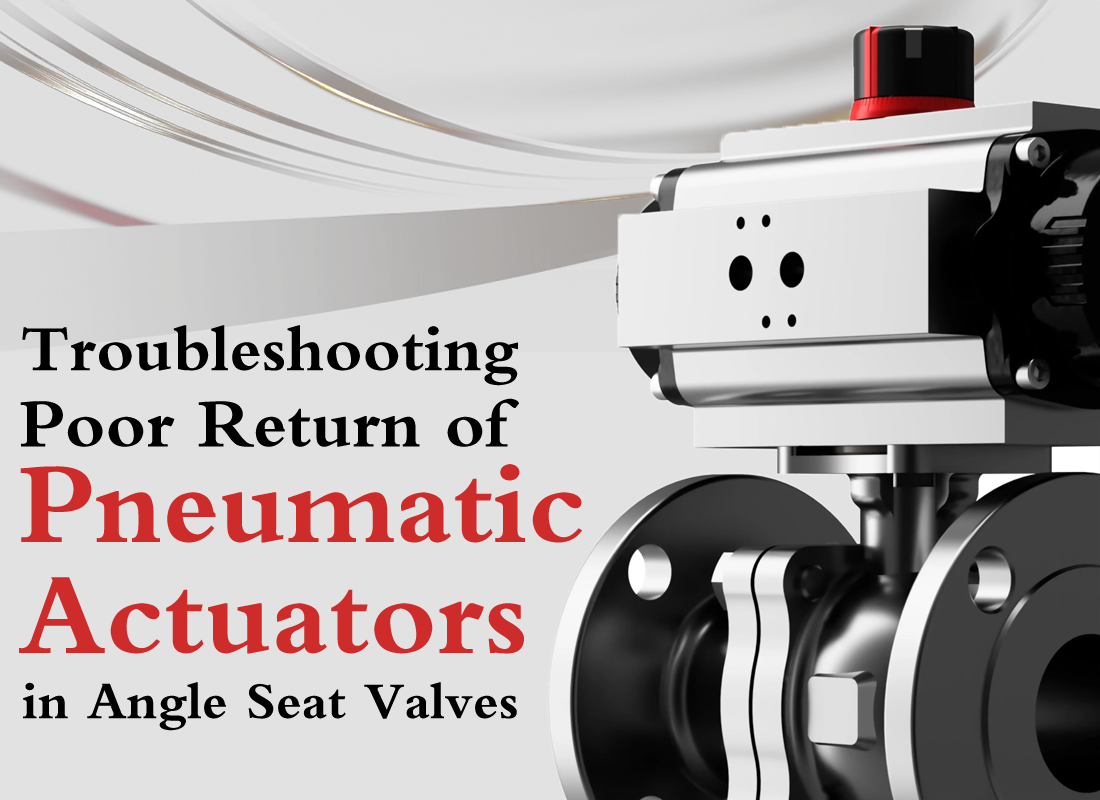
Angle seat valves are widely used in industrial automation due to their fast response, high flow capacity, and durability. However, engineers often encounter a common issue: after the control signal is released, the valve fails to return fully to its closed position. In most cases, the problem lies within the pneumatic actuator, not the control system.
Typical symptoms include slow closing, incomplete shut-off, or the actuator stopping midway. For spring return pneumatic actuators, the closing action relies entirely on internal spring force. When return performance degrades, the root cause is usually mechanical resistance or energy loss rather than air pressure control.
Spring fatigue is one of the most common and underestimated causes. In high-cycle applications, repeated compression reduces elastic force over time. Once the spring force drops below the friction level of the valve stem and seals, the actuator can no longer return reliably.
This issue is especially common in steam angle seat valves or high-temperature environments.
Poor air quality is another major factor affecting pneumatic actuator performance. Moisture, oil, or particles in compressed air can accumulate inside the actuator, increasing friction and slowing down the return stroke.
Checking the air filter regulator, drainage system, and overall air supply condition should always be part of the troubleshooting process.
Lack of lubrication leads to dry seals and worn guiding surfaces, resulting in actuator sticking. A practical test is manual assistance: if the actuator returns easily with light force, lubrication or contamination is likely the issue; if resistance is high, internal components may be damaged.
Sometimes the actuator itself is not defective. Incorrect actuator sizing, misalignment, or side load on the valve stem can significantly increase return resistance. In such cases, repeated spring replacement will not solve the issue.
Re-evaluating the angle seat valve actuator selection is essential for long-term reliability.
Field experience shows that checking spring condition, air quality, lubrication, and installation alignment in sequence helps engineers quickly identify the root cause. This systematic method reduces unnecessary part replacement and minimizes production downtime.
(FK9025)
You May Interest In



Get a free sample

FOKCA ©1998-2025 All Rights Reserved Sitemap