- sales@fokca.com info@fokca.com
- WhatsApp: +86 150 5749 1870

Custom Cylinders & System Solutions Manufacturer | Est. 1998
Custom Cylinders & System Solutions Manufacturer | Est. 1998

Jan 16, 2026
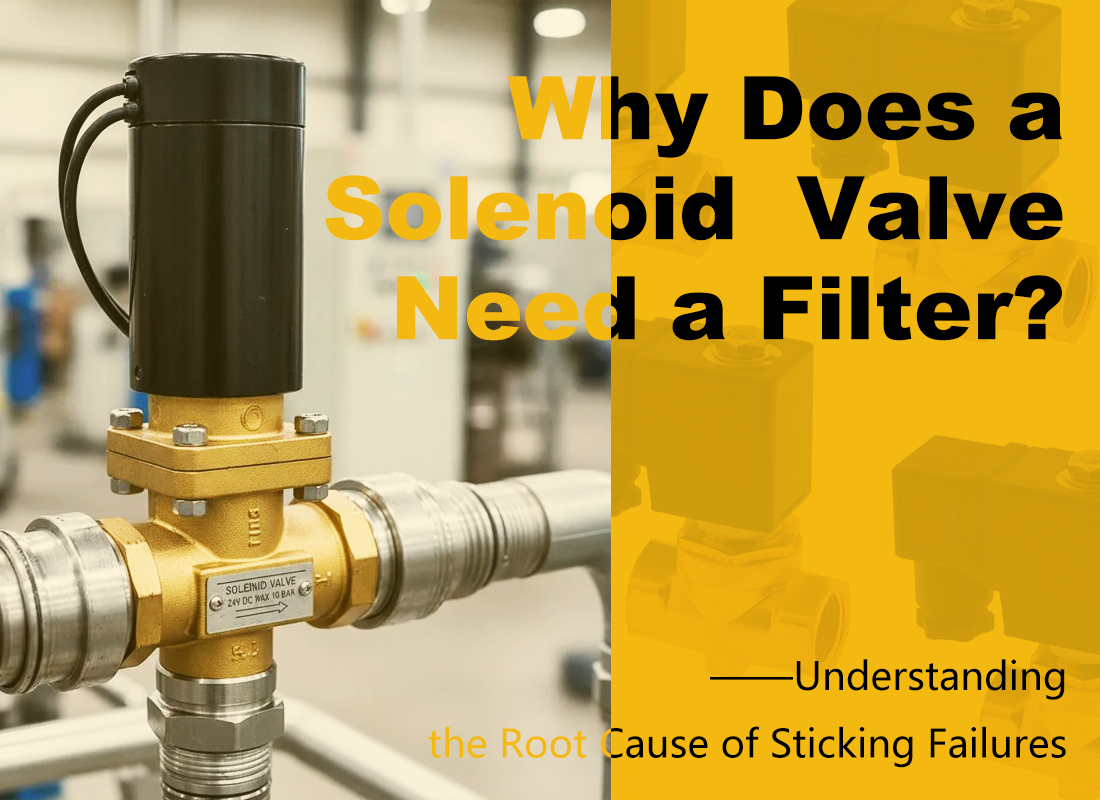
One of the most common failures in industrial solenoid valves is a stuck valve core. In many cases, engineers first suspect electrical issues or a damaged solenoid coil. However, field experience shows that contamination in the medium is often the real cause. Installing a proper filter upstream is one of the most effective ways to ensure long-term stable operation of a solenoid valve.
Even when working with water, air, or steam, the medium is rarely “clean.” Common contamination sources include pipe scale, rust particles, welding residue, PTFE tape fragments, and installation debris. In compressed air systems, oil mist, dust, and oxidation particles are also common over time.
These contaminants are often microscopic, yet they can seriously affect the internal movement of a solenoid valve.
Inside a solenoid valve, the valve core moves within a precisely machined guide with minimal clearance. Even tiny particles can disrupt this movement, leading to:
◆ Valve core sticking or slow response
◆ Internal leakage due to incomplete sealing
◆ Pilot orifice blockage in pilot-operated solenoid valves
Such problems often appear intermittently at first, making troubleshooting more difficult.
Unlike a burned-out solenoid coil, contamination-related failures tend to recur. Even after cleaning the valve, the problem will return if the contamination source remains. Over time, repeated sticking accelerates wear on the valve core and seat, eventually requiring full valve replacement.
Installing a filter before a solenoid valve provides a controlled operating environment. Proper filtration can:
◆ Prevent valve core sticking
◆ Reduce internal leakage
◆ Extend solenoid valve service life
◆ Improve system reliability and repeatability
In automated and unattended systems, filtration is essential for stable operation.
Choosing the right filter rating is a balance between protection and pressure drop. Common industry recommendations include:
| Application Type | Recommended Filter Rating |
|---|---|
| General air or water systems | 40–100 micron |
| Small or precision solenoid valves | 20–40 micron |
| Pilot-operated solenoid valves | ≤20 micron |
Over-filtration may increase maintenance frequency, while under-filtration offers insufficient protection.
Filters should be installed as close as possible to the solenoid valve inlet. Long pipe sections between the filter and valve can reintroduce contaminants. Filters should also be accessible for regular inspection and cleaning.
Experienced engineers know that medium quality matters as much as valve design. Selecting a high-precision solenoid valve without addressing contamination risks often leads to premature failure. In many cases, a properly selected filter does more to improve system reliability than upgrading the valve itself.
A solenoid valve filter is not an optional accessory—it is a core reliability component. Most valve core sticking issues are not caused by poor valve quality but by inadequate contamination control. Addressing filtration early can eliminate the majority of solenoid valve failures and significantly reduce maintenance costs over time.
(FK9025)
You May Interest In
Dec 31, 2025 Blog
Pneumatic Solenoid Valve Manual Button Explained



Get a free sample

FOKCA ©1998-2025 All Rights Reserved Sitemap