- sales@fokca.com info@fokca.com
- WhatsApp: +86 150 5749 1870

Custom Cylinders & System Solutions Manufacturer | Est. 1998
Custom Cylinders & System Solutions Manufacturer | Est. 1998

Jan 15, 2026
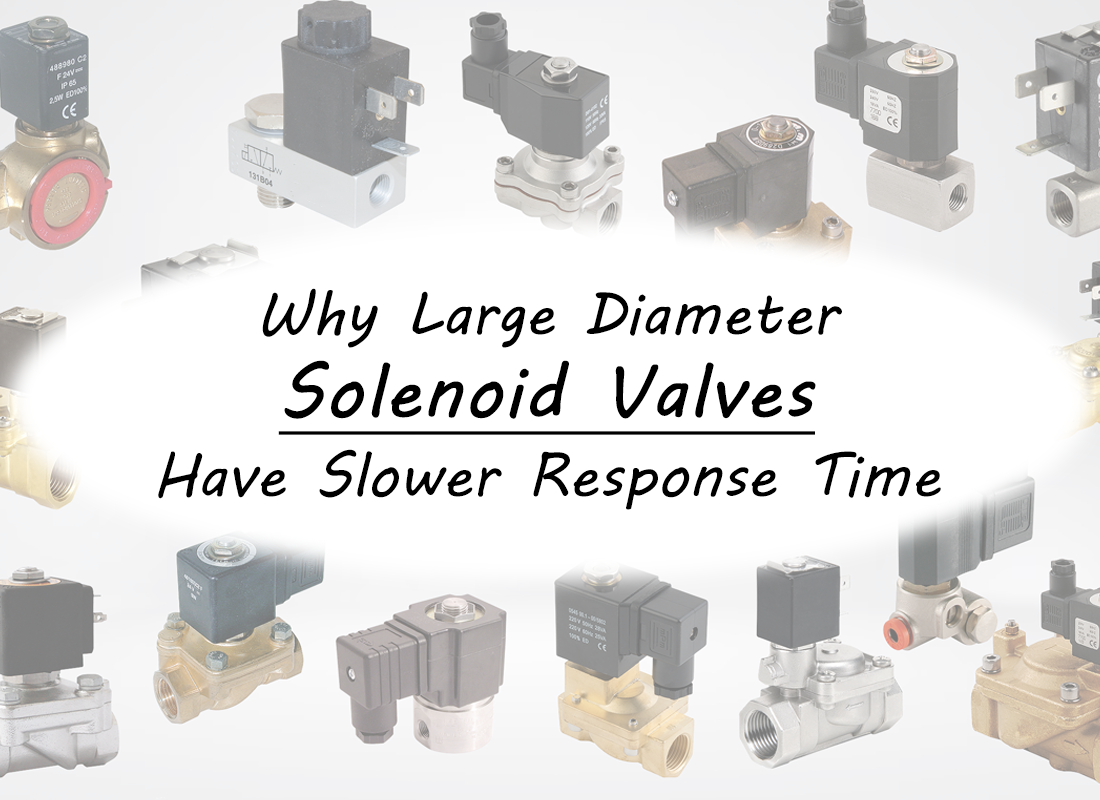
In many industrial fluid systems, increasing valve size seems like a straightforward solution when higher flow rates are required. However, engineers often notice an unexpected side effect: large diameter solenoid valves respond noticeably slower than smaller ones.
This delay is not a manufacturing flaw or a coil quality issue. It is the result of fundamental physical limits built into solenoid valve operation.
Understanding these limits helps engineers avoid unrealistic expectations and make better valve selection decisions.
In fluid control systems, valve diameter directly affects both flow capacity and force balance. As the orifice size increases, the effective area exposed to system pressure grows rapidly. Even under the same operating pressure, a larger solenoid valve experiences significantly higher closing force on the valve plunger.
At the same time, high flow systems often involve higher flow velocity and pressure fluctuations. These conditions increase resistance during valve actuation and make fast response more difficult to achieve.
As a result, large diameter solenoid valves naturally operate in a different dynamic range than small ones.
A solenoid valve relies on electromagnetic force generated by its coil to lift the plunger. In theory, increasing coil power can produce stronger magnetic force. In practice, this approach quickly reaches its limits.
As valve size increases, the required magnetic force grows much faster than coil efficiency. Higher power coils generate more heat, consume more energy, and reduce long-term reliability. Excessive coil temperature also shortens insulation life and increases failure risk.
Because of these constraints, magnetic force does not scale proportionally with valve diameter, making slower response unavoidable in large solenoid valves.
Another critical factor is plunger mass. Large diameter solenoid valves require larger and heavier plungers to maintain structural strength and sealing stability. A heavier plunger means higher inertia.
From a mechanical perspective, inertia resists changes in motion. Even with sufficient electromagnetic force, accelerating a heavier plunger takes more time. Deceleration during closing is also slower, especially when spring force is limited by design constraints.
This is why large solenoid valves often show delayed opening and closing, particularly in applications involving frequent switching.
System pressure plays a major role in response time. In high-pressure water, steam, or compressed air systems, pressure acts directly on the plunger surface.
As valve diameter increases, the pressure-induced force increases dramatically.
To manage this, many large solenoid valves adopt a pilot operated design, using pressure balancing to reduce the force required from the coil. While effective, pilot operation introduces another delay: pressure equalization takes time.
This means that pilot operated solenoid valves trade response speed for higher flow capacity and pressure handling.
| Factor | Small Diameter Solenoid Valve | Large Diameter Solenoid Valve |
|---|---|---|
| Plunger weight | Light | Heavy |
| Magnetic force requirement | Low | Very high |
| Pressure acting area | Small | Large |
| Typical response time | Fast | Slower |
| Control frequency | High | Limited |
| Common structure | Direct acting | Pilot operated |
In many applications, engineers assume faster response is always desirable. In reality, system stability matters more than raw speed. Large diameter solenoid valves are typically used in:
◆ Water distribution systems
◆ Industrial cooling loops
◆ Steam or thermal oil lines
◆ Process media isolation
These systems prioritize reliable shutoff, durability, and flow capacity over millisecond-level response.
Attempting to force high-speed performance from a large solenoid valve often leads to coil overheating, noise, vibration, and reduced service life.
Instead of oversizing solenoid valves, engineers should consider alternative solutions:
◆ For high flow and fast response: angle seat valves with pneumatic actuators
◆ For continuous modulation: control valves instead of on/off solenoid valves
◆ For high pressure isolation: pilot operated solenoid valves with realistic response expectations
Understanding the physical limits behind solenoid valve response time allows better system design and fewer field problems.
Large diameter solenoid valves are not slow because they are poorly designed. They are slower because physics sets clear boundaries on electromagnetic actuation, plunger dynamics, and pressure balance.
Recognizing these limits leads to smarter valve selection, longer service life, and more stable system performance—especially in demanding industrial environments.
(FK9025)
You May Interest In

Dec 31, 2025 Blog
Pneumatic Solenoid Valve Manual Button Explained



Get a free sample

FOKCA ©1998-2025 All Rights Reserved Sitemap