- sales@fokca.com info@fokca.com
- WhatsApp: +86 150 5749 1870

Custom Cylinders & System Solutions Manufacturer | Est. 1998
Custom Cylinders & System Solutions Manufacturer | Est. 1998

Mar 27, 2026
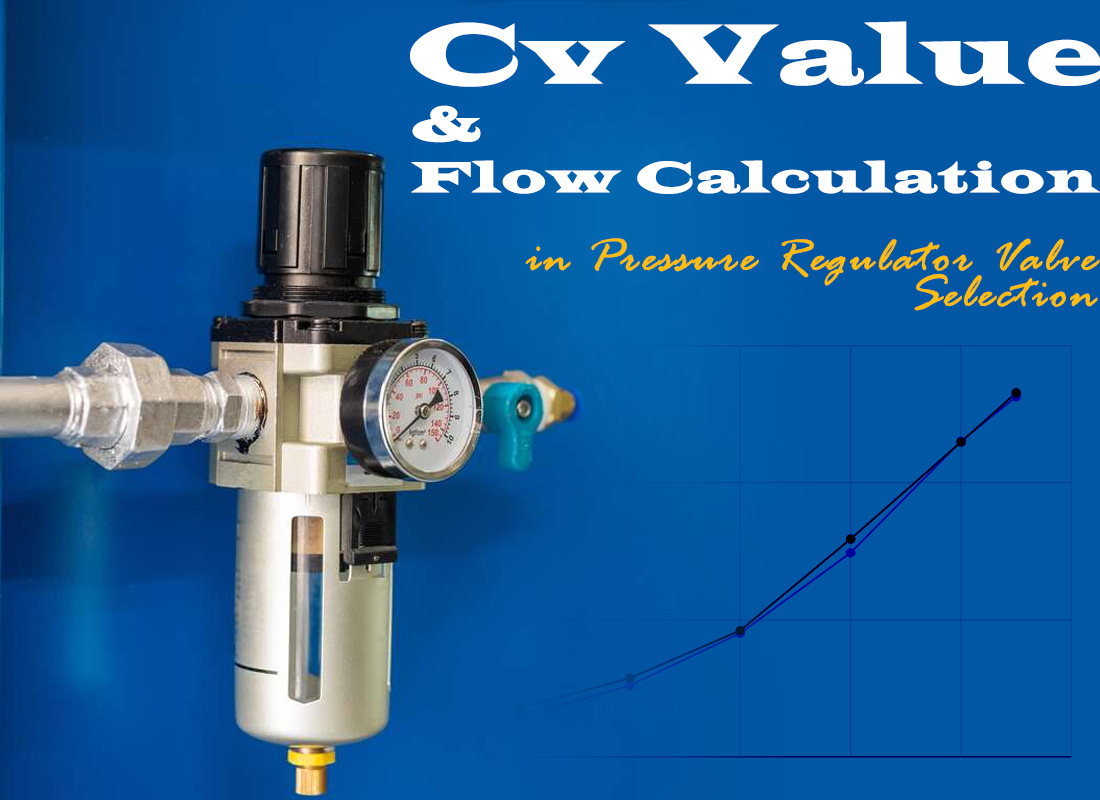
In any pressure regulator valve application, flow capacity is just as critical as pressure control. The Cv value, defined as the flow rate of water (in GPM) passing through a valve at a 1 psi pressure drop, is the key parameter used to size valves correctly.
For engineers selecting a water pressure regulator valve or air pressure regulator valve, misunderstanding Cv often leads to unstable downstream pressure or insufficient flow. A valve with an incorrect Cv may technically regulate pressure but fail to meet real system demand.
Understanding how Cv connects flow, pressure drop, and valve size is essential for reliable system design.
The relationship between Cv and flow is based on standard fluid dynamics equations. For liquids such as water, the commonly used formula is:
Q = Cv × √(ΔP / SG)
Where:
• Q = Flow rate (GPM)
• Cv = Flow coefficient
• ΔP = Pressure drop (psi)
• SG = Specific gravity (water = 1)
In a typical pressure regulating valve for water, if the required flow and allowable pressure drop are known, the Cv can be calculated directly.
For gases, such as in a gas pressure regulator valve, the calculation becomes more complex due to compressibility, but the principle remains similar—Cv defines the valve’s ability to pass flow under given conditions.
Consider a system requiring 10 GPM flow with an allowable pressure drop of 4 psi.
Using the formula:
Cv = Q / √ΔP = 10 / √4 = 10 / 2 = 5
This means a pressure valve regulator with a Cv of at least 5 is required.
If a smaller valve, such as a 3/4 inch pressure regulator valve, has a Cv of only 3.5, it will restrict flow and cause downstream pressure fluctuations.
This type of mismatch is commonly seen in home water pressure regulator valve installations where sizing is based only on pipe diameter instead of flow requirements.
The table below shows typical Cv ranges for commonly used valves (data source type: manufacturer catalogs and engineering references):
| Valve Size | Typical Cv Range | Application Example | Valve Type |
|---|---|---|---|
| 1/2 inch | 1.5 – 3 | Small residential flow | Home water pressure regulator valve |
| 3/4 inch | 3 – 6 | Household / light commercial | Water pressure regulating valve |
| 1 inch | 5 – 10 | Industrial water systems | Pressure regulator valve for water |
| 1-1/4 inch | 8 – 15 | High flow applications | Air pressure regulating valve |
These values vary depending on valve design, but they provide a practical starting point for selection.
An undersized Cv limits flow capacity. Even if the pressure regulating valve is fully open, it cannot deliver the required flow, resulting in pressure drop and system inefficiency.
On the other hand, an oversized Cv may reduce control accuracy. In a compressed air pressure regulating valve, excessive Cv can cause unstable pressure regulation due to reduced sensitivity to small changes.
This balance is especially critical in applications such as air compressor pressure regulator valve systems, where both flow and pressure stability are required simultaneously.
In practice, selecting Cv is not just about calculation. It involves understanding system dynamics.
First, determine the maximum and normal operating flow rates. Then define acceptable pressure drop limits based on system design.
Next, compare calculated Cv with manufacturer data. For example, when selecting a 1 inch water pressure regulator valve, ensure the Cv range covers peak demand without exceeding optimal operating conditions.
Finally, consider future expansion. Systems often evolve, and selecting a slightly higher Cv (within control limits) can provide flexibility.
In real installations, engineers often encounter cases where valves perform poorly despite correct pressure settings. In many of these cases, the root cause is incorrect Cv selection rather than a faulty valve.
For instance, in a packaging system using compressed air, insufficient Cv can result in slow actuator response, even when the air pressure regulator valve with gauge shows correct pressure.
This highlights the importance of combining pressure control knowledge with flow capacity analysis when selecting a valve.
For engineers, distributors, and system designers:
◆ Always calculate Cv based on actual flow and pressure drop
◆ Avoid selecting valves based only on pipe size
◆ Check manufacturer Cv curves for accurate sizing
◆ Balance flow capacity with pressure control accuracy
◆ Re-evaluate Cv when system demand changes
(FK9025)
You May Interest In











Get a free sample

FOKCA ©1998-2025 All Rights Reserved Sitemap