- sales@fokca.com info@fokca.com
- WhatsApp: +86 150 5749 1870

Custom Cylinders & System Solutions Manufacturer | Est. 1998
Custom Cylinders & System Solutions Manufacturer | Est. 1998

Mar 31, 2026
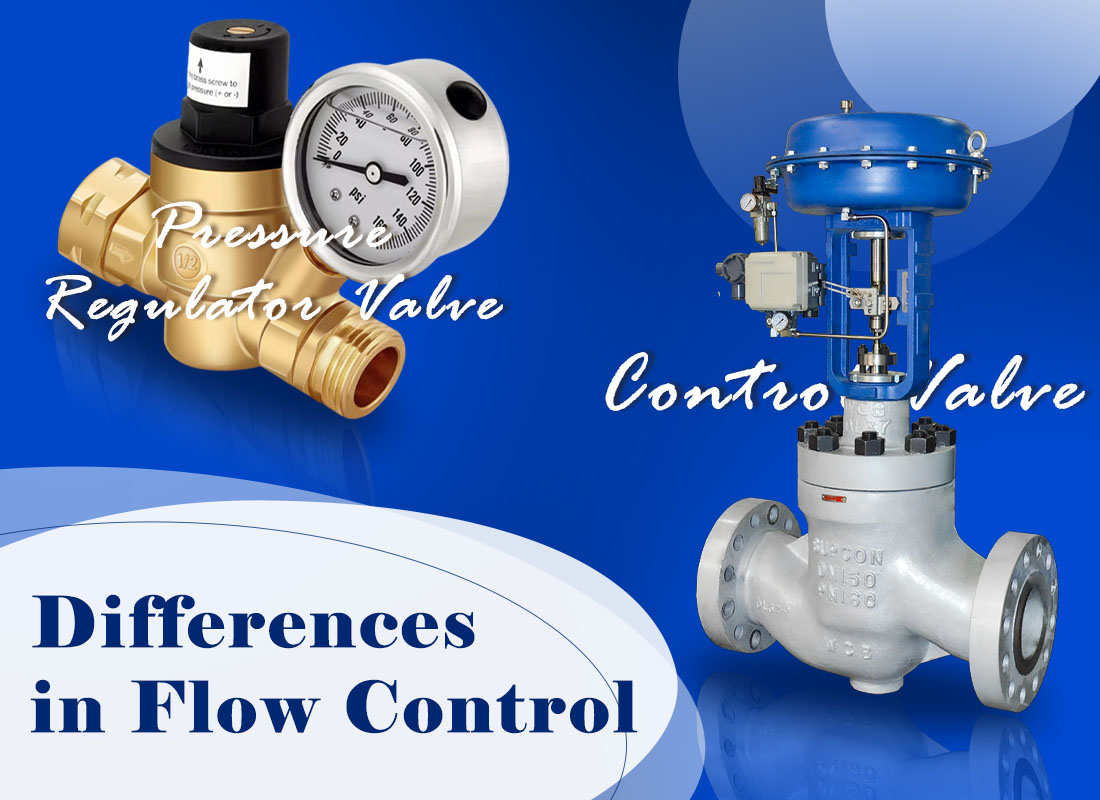
In fluid systems, a pressure regulator valve is designed primarily to maintain a constant downstream pressure regardless of upstream fluctuations. While it indirectly affects flow, its core logic is pressure-based rather than flow-based.
In applications such as a water pressure regulator valve or gas pressure regulator valve, the valve automatically adjusts opening based on downstream pressure feedback. This makes it highly suitable for systems where pressure stability is the priority, even when flow demand changes.
However, this control method means that flow is a result, not the primary control target.
A control valve operates with a fundamentally different principle. It regulates flow directly by adjusting valve position based on an external signal, often from a controller or sensor.
In systems using an air pressure regulator valve or automated process control, a control valve can precisely modulate flow rate according to process requirements.
Unlike a pressure regulating valve, which reacts passively to pressure changes, control valves actively follow setpoints such as flow rate, temperature, or level. This makes them essential in industrial automation and process industries.
The difference in control logic defines how these valves behave in real applications.
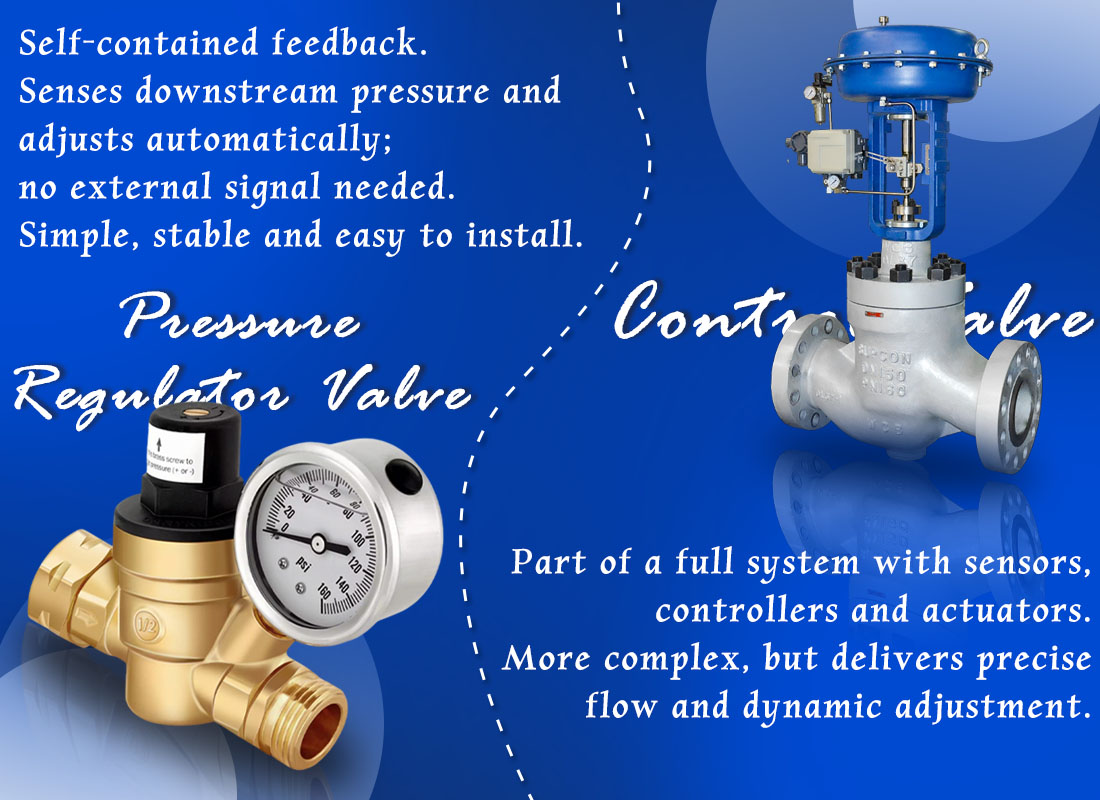
A pressure valve regulator works on a self-contained feedback loop. It senses downstream pressure and adjusts accordingly without external input. This simplicity makes it reliable and easy to install.
A control valve, by contrast, is part of a larger control system. It requires sensors, controllers, and sometimes actuators to function. While more complex, it allows for precise flow control and dynamic adjustment.
This distinction is critical when selecting between a pressure regulator valve for water and a control valve in systems where flow accuracy is important.
Accuracy and response speed vary significantly between the two valve types.
A pressure regulator valve offers stable pressure control but limited flow accuracy. Its response is typically smooth but slower, as it depends on pressure feedback.
Control valves provide higher accuracy in flow regulation, especially in systems like chemical dosing or steam control. Their response speed is faster because they react directly to control signals rather than waiting for pressure changes.
This makes control valves more suitable for dynamic systems, while pressure regulating valves excel in steady-state conditions.
| Parameter | Pressure Regulator Valve | Control Valve |
|---|---|---|
| Control Objective | Maintain pressure | Control flow directly |
| Control Method | Self-operated | External control system |
| Accuracy | Moderate | High |
| Response Speed | Medium | Fast |
| System Complexity | Low | High |
| Typical Application | Water supply, gas systems | Industrial process control |
| Example Type | Home water pressure regulator valve | Automated flow control valve |
In residential and utility systems, such as those using a home water pressure regulator valve, maintaining consistent pressure is more important than precise flow control. In these cases, a regulator valve is the practical choice.
In contrast, industrial systems like chemical processing or compressed air distribution often require precise control over flow rate. Here, control valves outperform standard pressure regulator valves due to their responsiveness and adaptability.
There are also hybrid scenarios. For example, a system may use a pressure regulator valve upstream for pressure stabilization and a control valve downstream for flow fine-tuning.
Choosing between these two valve types should always begin with defining the primary control objective. If the goal is to stabilize pressure with minimal complexity, a regulator valve is sufficient.
If the process requires continuous adjustment and high precision, a control valve becomes necessary despite higher cost and complexity.
Engineers should also consider maintenance, installation conditions, and system scalability when making a decision.
(FK9025)
You May Interest In



Get a free sample

FOKCA ©1998-2025 All Rights Reserved Sitemap