- sales@fokca.com info@fokca.com
- WhatsApp: +86 150 5749 1870

Custom Cylinders & System Solutions Manufacturer | Est. 1998
Custom Cylinders & System Solutions Manufacturer | Est. 1998

Jan 21, 2026

In industrial automation, 2 way solenoid valves are essential components for fluid control. While they are designed primarily for on/off control, many of these valves feature reduced orifices inside, which can significantly impact system performance. Understanding how flow path reduction affects pressure drop, flow rate, and energy consumption is critical in optimizing system design.
Flow path reduction refers to the condition where the valve’s internal flow area is smaller than the nominal pipe diameter. Many 2 way solenoid valves are designed with reduced valve orifices to control fluid flow more precisely. While this design works well for low flow applications, it can create significant pressure losses in systems requiring higher flow rates.
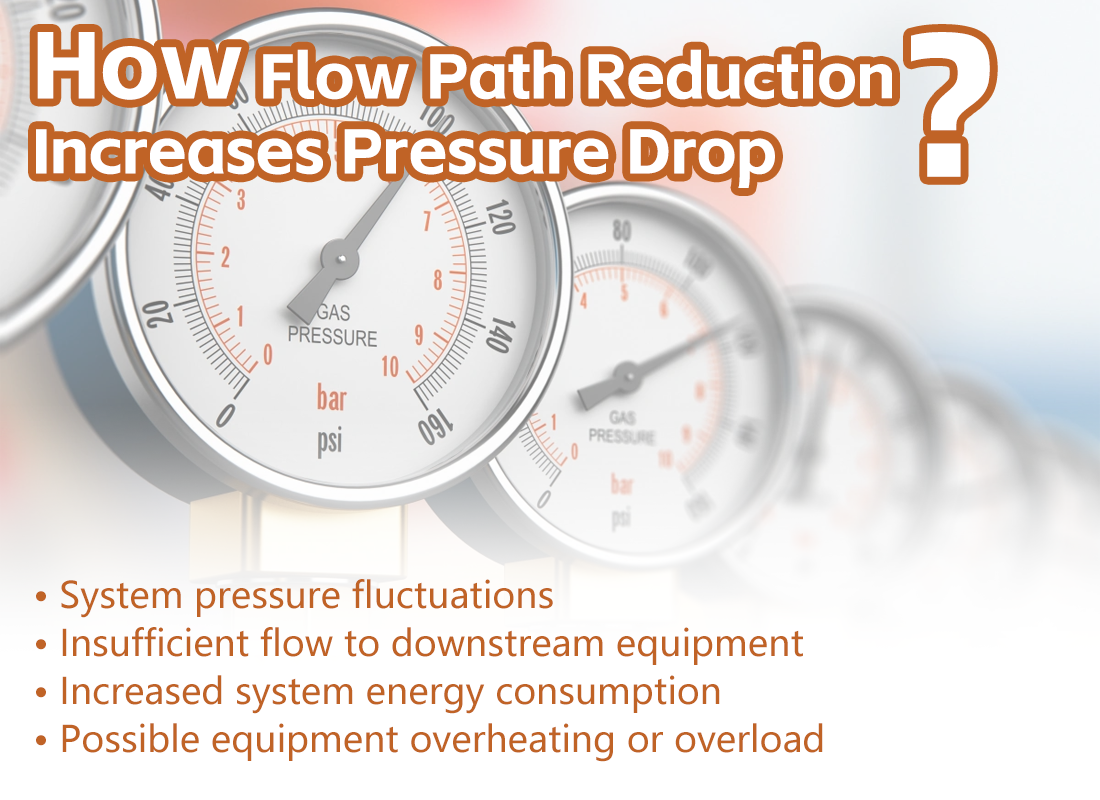
As fluid passes through a smaller orifice, its velocity increases, leading to a decrease in static pressure. This pressure drop is inevitable, and it directly affects the overall system efficiency. For high-pressure systems, this pressure loss becomes more pronounced, resulting in:
◆ System pressure fluctuations
◆ Insufficient flow to downstream equipment
◆ Increased system energy consumption
◆ Possible equipment overheating or overload
In complex systems, this accumulated pressure loss can cause the system to underperform or lead to instability.
Orifice size in a solenoid valve has a direct impact on its flow capacity. A smaller orifice size reduces the flow rate, while a larger orifice allows more fluid to pass through. When the orifice is too small, it may become a bottleneck in high-flow applications, regardless of the pipe size.
Although the immediate pressure loss due to flow restriction may seem negligible, long-term operation magnifies its impact. To compensate for the pressure loss, the system often requires higher pressure or longer pump runtimes, directly increasing energy consumption.
When selecting a 2 way solenoid valve, it’s essential to understand the system’s flow requirements. For high-flow applications, choose a full-bore solenoid valve or a valve with a larger orifice size to avoid excessive pressure drop and energy consumption.
For low-flow applications, select a valve with a smaller orifice size to control flow precisely, but avoid using small orifices in high-flow systems.
◆ Minimize flow path reductions: Reduce sharp turns and narrow pipe sections before and after the valve to prevent unnecessary pressure losses.
◆ Add bypass designs: For high-flow systems, incorporate bypass systems to divert pressure and reduce valve load.
◆ Choose appropriate valve types: For large flow systems, use angle seat valves or ball valves to avoid the negative effects of reduced orifice sizes.
Flow path reduction is an inherent design feature of 2-way solenoid valves, but it can significantly impact system performance, particularly in high-flow applications. By understanding the relationship between orifice size, pressure drop, and energy efficiency, engineers can make better valve selections and optimize system designs to ensure stability and energy savings.
(FK9025)
You May Interest In









Dec 31, 2025 Blog
Pneumatic Solenoid Valve Manual Button Explained



Get a free sample

FOKCA ©1998-2025 All Rights Reserved Sitemap